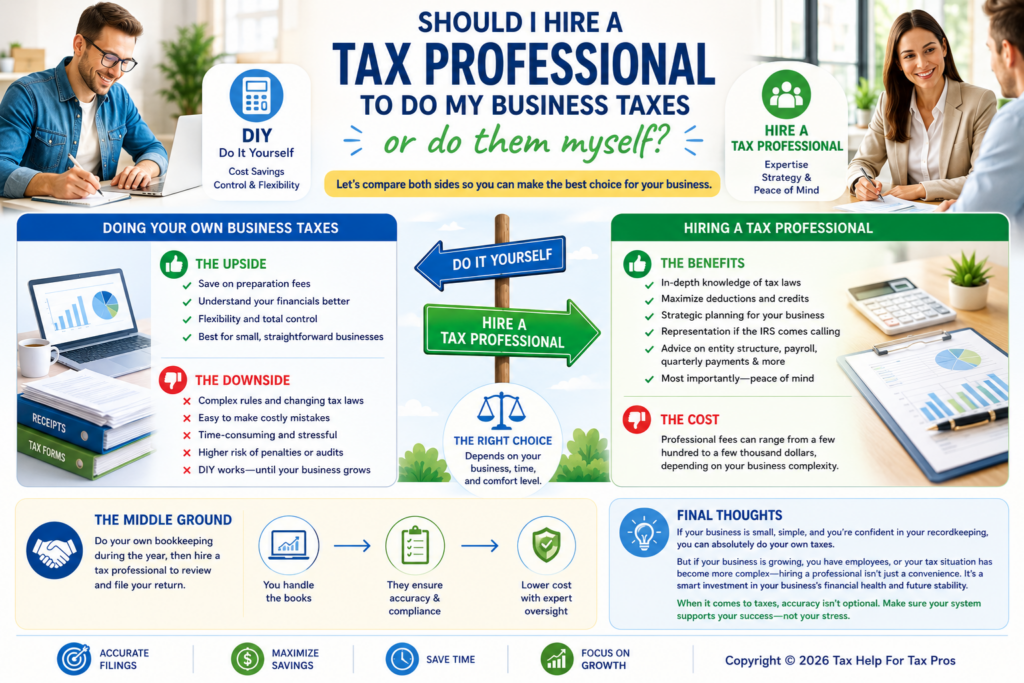
Question: Should I hire a tax professional to do my business taxes or do them myself?
It’s a question every business owner asks at some point: should I handle my own business taxes or bring in a professional?
While doing it yourself might seem like a cost-saving move, hiring a tax professional could save you far more in the long run — in both money and stress. Let’s look at both sides of the decision so you can make the best choice for your business.
Doing Your Own Business Taxes
At first glance, doing your own taxes feels like the simplest route. You already know your business inside and out — so why not take control of your filings, too?
The Upside
The main advantage is cost savings. You won’t be paying preparation fees, and if your business is small or straightforward — say, a sole proprietorship or single-member LLC — using accounting software like QuickBooks or TurboTax Business can make the process manageable.
You’ll also gain a deeper understanding of your financials. Handling your own taxes helps you see where your money is going, how much profit you’re really making, and what deductions you can claim in future years.
And let’s be honest — there’s something satisfying about having total control and flexibility over the timing of your filings.
The Downside
But here’s the flip side: business taxes aren’t simple. They’re a maze of rules, changing laws, and complex deductions that vary based on your business structure.
Even a small mistake — like misclassifying an expense or missing a filing deadline — can lead to costly penalties. Add in the hours spent gathering receipts, reading IRS publications, and double-checking forms, and it quickly becomes clear: your time might be better spent running your business.
DIY taxes make sense for smaller, straightforward setups — but as soon as your operations expand, so do the risks.
Hiring a Tax Professional
When you work with a CPA or Enrolled Agent, you’re getting more than just someone to fill out your forms — you’re getting expertise, strategy, and peace of mind.
The Benefits
A tax professional stays on top of constantly changing tax laws and knows how to apply them to your specific business situation. They’ll help you capture every deduction and credit you’re entitled to, while also planning ahead for next year.
If the IRS comes calling, a CPA or EA can represent you during an audit, ensuring you’re protected and prepared.
More importantly, hiring a professional turns your tax filing into a strategic advantage. They can advise you on entity structure, quarterly payments, payroll taxes, depreciation schedules — all the behind-the-scenes decisions that can save you thousands.
And let’s not overlook the biggest benefit: peace of mind. When you know your taxes are accurate and compliant, you can focus on growing your business instead of worrying about what you might have missed.
The Cost
Of course, expertise comes with a price. Tax professionals may charge anywhere from a few hundred to a few thousand dollars depending on your business complexity. But for many owners, that cost is more than justified when compared to potential mistakes, missed deductions, or audit risks.
The Middle Ground
There’s also a hybrid approach that works for many small business owners: handle your own bookkeeping during the year, then hire a tax professional to review and file the return.
That way, you keep costs lower but still get professional oversight to ensure compliance and accuracy.
Final Thoughts
If your business is small, simple, and you’re confident in your recordkeeping, you can absolutely do your own taxes.
But if your business is growing, you have employees, or your tax situation has become more complex — hiring a professional isn’t just a convenience. It’s a smart investment in your business’s financial health and future stability.
When it comes to taxes, accuracy isn’t optional. Whether you do it yourself or bring in an expert, make sure your system supports your success — not your stress.