What Business Expenses Are Fully Deductible vs. Partially Deductible?
If you’re a business owner, you’ve probably asked yourself this at least once:
“Can I write this off?” As a tax professional, I hear it all the time. While it may seem like a simple yes or no answer, the truth is that not all business expenses are treated equally when it comes to deductions.
Some expenses are fully deductible, meaning you can write off 100% of the cost. Others are only partially deductible due to IRS limitations. And then there are a few that might surprise you with how little (or how much) you can actually claim.
Fully Deductible Expenses: The Everyday Essentials
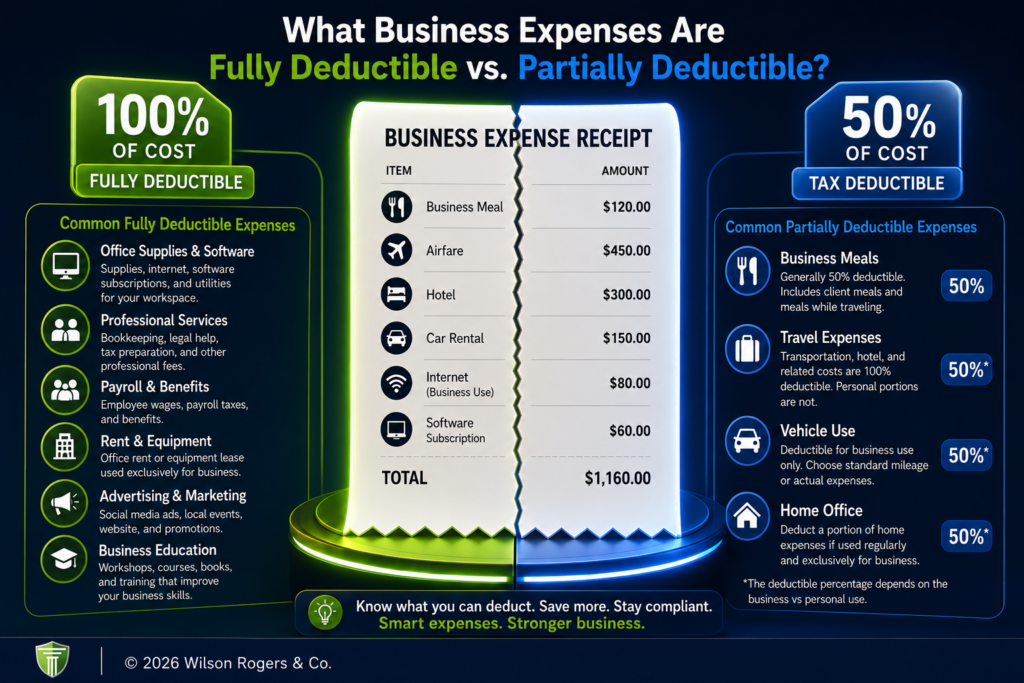
Many of the expenses you incur while running your business are completely deductible. These are your bread-and-butter costs—necessary, ordinary expenses that keep your operations going. Some examples include the following:
- Office supplies, internet bills, software subscriptions, and utility costs tied to your workspace
- Professional services like bookkeeping, legal help, or tax preparation fees
- Paying employees along with your share of payroll taxes and benefits
- Renting an office or leasing equipment exclusively for your business
- Advertising through social media, local events, or your website
- Even business education—like attending a workshop, buying industry books, or taking a course that helps you improve your skills—is often fully deductible when it directly supports your trade.
The bottom line: if the expense is necessary for your business and doesn’t have a personal use component, there’s a good chance it’s fully deductible.
Partially Deductible Expenses: The “Use With Caution” Category
Now, let’s talk about the gray area. Some business expenses are considered only partially deductible, which means you’ll only be able to claim a portion of the cost on your taxes.
Take meals, for example. Business meals are generally 50% deductible, not 100%. That includes client lunches, dinner on a business trip, or grabbing food during a full day of meetings. In some rare cases—like meals provided to employees on-site for the employer’s convenience or company holiday parties—the deduction can be 100%, but these are exceptions, not the rule.
Travel expenses are another area that often gets misunderstood. Flights, hotels, baggage fees, and transportation are usually fully deductible as long as the trip is business-related. But once you mix in personal travel—or bring your spouse or family along—you’ll need to carefully separate the deductible business portion from any personal costs, which are not deductible.
Vehicle use is also commonly misused. While driving for business purposes is deductible, commuting from home to your regular office is not. You can choose to deduct either the IRS standard mileage rate or your actual vehicle expenses—but only for the percentage of the time your vehicle is used for business.
And then there’s the home office deduction. This one’s helpful but highly specific: to qualify, your home office must be a dedicated space used regularly and exclusively for business. That means no using the guest room you occasionally work in. If it meets the criteria, you can deduct a portion of your home expenses like utilities, rent, and even repairs.
A Few Expenses That Often Surprise Business Owners
Even experienced business owners get tripped up on some deductions. Clothing, for instance, is not deductible unless it’s a uniform or protective gear that’s required for your job. That stylish blazer you wore to a networking event? Unfortunately, it’s a personal expense—even if it was business-related.
Client gifts also come with a limit: only $25 per recipient, per year is deductible, no matter how generous your intentions were.
Why It Matters: Deductions Done Right Can Save You Thousands
Accurately classifying your business expenses can make a huge difference when tax time rolls around. Not only does it help lower your tax bill, but it also keeps you compliant with IRS regulations.
More importantly, knowing what you can and can’t deduct allows you to be more intentional about how you spend your money. You can invest with confidence in the parts of your business that provide the most value—and get the best tax return in the process.
Final Thoughts from a Tax Professional
Understanding what you can and can’t deduct is one of the most powerful tools you have as a business owner. While not every expense qualifies, many do as long as you approach them with clarity and strategy. The key is making sure your deductions are not only accurate but working for you. That’s where a knowledgeable tax professional comes in. Whether you need help tracking expenses, planning ahead, or staying compliant, expert guidance can turn guesswork into confident, money-saving decisions.
If you’re unsure whether you’re making the most of your deductions, let’s talk. A bit of proactive planning today can mean fewer headaches and more savings when tax season rolls around.