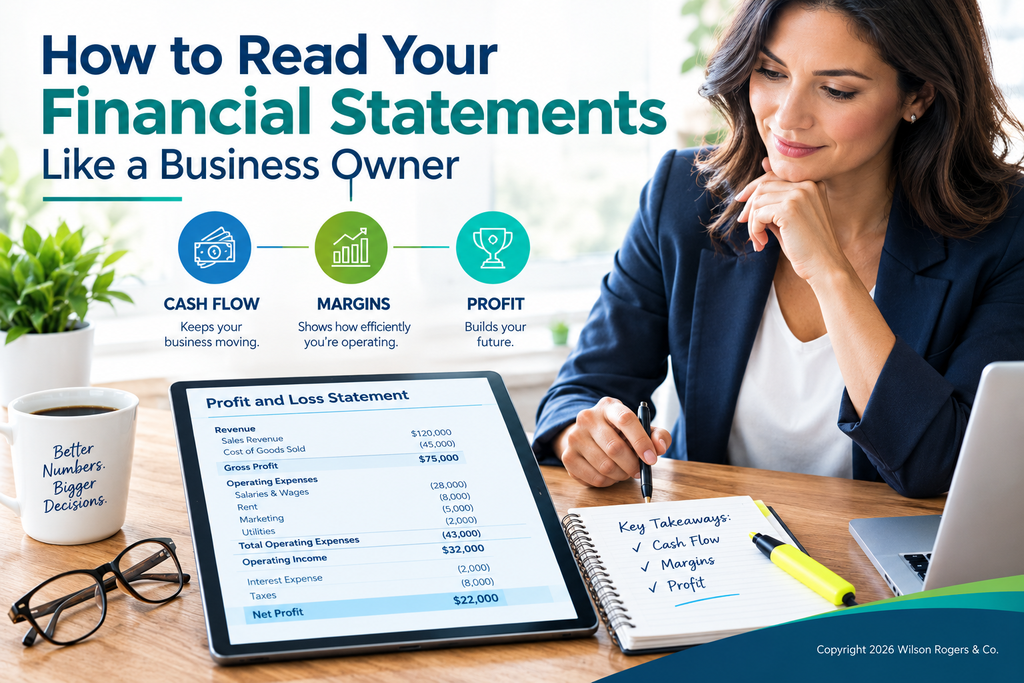
Why Financial Reports Matter
Most owners did not start a company to read financial statements. Yet, your reports tell the story of your business far better than your bank account ever could.
You do not need an accounting degree to understand the basics. Mastering three core financial statements allows you to spot issues early, make smarter decisions, and have more productive conversations with your advisor.
1. Profit & Loss Statement (Income Statement)
Your P&L acts as a report card for a specific period, answering one critical question: “Did my business make money?”
- Key components: Revenue, Cost of Goods Sold (COGS), Gross Profit, Operating Expenses, and Net Profit.
- Why it matters: While most owners look straight at Net Profit, pay close attention to expenses. If software, payroll, or marketing costs outpace sales, profitability quietly shrinks.
2. Balance Sheet
While P&L tracks performance over time, the Balance Sheet offers a snapshot of your financial standing today.
- The core formula:
- Assets: What your business owns.
- Liabilities: What your business owes.
- Equity: The value left for the owner after liabilities are paid.
- Why it matters: It answers whether you have enough cash, carry too much debt, and are building long-term financial stability.
3. Cash Flow Statement
A profitable business can still run out of cash because profit and cash are not the same thing.
- What it measures: How money moves in and out of your business across operating, investing, and financing activities.
- Why it matters: It explains why your bank balance differs from your P&L and helps you identify tight cash flow before it turns into a crisis.
Look Beyond Revenue
It is easy to celebrate growing sales, but revenue alone tells an incomplete story. Regularly ask yourself:
- Are my profits growing too?
- Are expenses and cash flow under control?
- Am I building equity?
Evaluating all three statements together provides a complete picture of your financial health.
Track Trends, Not Just Single Months
Financial statements become powerful when compared over time. Instead of asking how you did this month, look for trends:
- Is revenue steadily increasing?
- Are expenses staying managed?
- Is cash flow becoming consistent?
Spotting these trends early reveals opportunities—and problems—long before they become obvious.
The Core Numbers Every Owner Should Monitor
While every business is unique, most owners should regularly track:
- Revenue & Gross/Net Profit
- Cash on Hand
- Accounts Receivable & Accounts Payable
These metrics provide a quick, reliable snapshot to guide your everyday operational decisions.
Get Expert Financial Support
Too many business owners only review their financials at tax time. Instead, use them as tools to drive growth—whether you are hiring, buying equipment, or adjusting pricing.